Linux Kernel Mailing List archive Case Study

Quick Highlights
- Made the entire Linux Kernel Mailing List archive work properly on mobile devices.
- Achieved it through upstream contributions to Public Inbox, the infrastructure powering lore.kernel.org.
- Advocated for use of his upstream feature to make lore.kernel.org render properly on mobile.
- Followed with dark-theme visibility work for form controls, landing a contrast fix and a full dark sample theme within the project's 216 and 22 web-safe color constraints.
Background:
Public Inbox is the open source software that powers lore.kernel.org, the official archiving platform for the Linux Kernel Mailing List and dozens of other kernel sub-lists. It is a significant piece of infrastructure: the Linux kernel is developed almost entirely through email, and lore.kernel.org is where those discussions are permanently archived and publicly searchable.
Public Inbox is created and maintained by a single developer: Eric Wong. Eric is a respected figure in the systems programming world - he is the original author of Unicorn, the Ruby HTTP server that powered Twitter and Shopify at scale and whose pre-fork server architecture later influenced Gunicorn. His approach to software reflects those roots: minimal dependencies, extreme efficiency, and a very high bar for any change that touches the system.
Critically, Public Inbox is not a standard website. It is infrastructure for generating mailing list archives intended for both graphical web browsers and terminal text-based browsers as first-class audiences. That dual-audience constraint shapes every design decision on the platform.
How The Problem Surfaced:
Rito landed on lore.kernel.org on his phone and immediately hit the familiar panzoom dance - the desktop-first layout with no viewport meta tag meant pinch-zooming and panning just to read a thread. The site was fully functional for its intended desktop and terminal audiences, but on a mobile browser it was effectively unusable.
Since Public Inbox is open source, a custom CSS patch to the hosted instance was technically possible. But the right move was to go upstream: a change to Public Inbox itself would benefit every instance, not just lore.kernel.org. That was the approach.
First Patches & Eric's Response:
Rito submitted the initial patches and they were rejected. The objection was not to the implementation, it was to the premise. In a detailed reply, Eric asked why mobile was something the project should support or encourage at all, questioned how many people review patches on a phone, and pointed to a similar discussion years earlier that had gone nowhere. He also would not be viewing the before and after screenshots attached to the series, and the reason was a position rather than a refusal: he does not run a graphical browser, and does not consider the millions of lines of driver and firmware code one depends on a reasonable thing to expect of contributors working on daemons and command line tools.
That is the constraint worth understanding. The case had to be made to a reviewer who was unconvinced the problem was worth solving and who, on principle, would never see the result. Screenshots and visual argument were off the table entirely.
It was a dismissal, but also a useful redirection - it was actionable. Eric gave guidance on how to align the layout fixes with his vision and how to approach a more general tag injection, since he rejected viewport meta tags and favicons as categorical defaults.
Rito took that feedback and iterated. There was already an existing mechanism for injecting CSS into the head - he took that as the foundation and expanded it. His first pass was an opinionated feature with structured support for specific tag types he believed would be useful to admins who are not web developers: viewport meta tag, favicons, Open Graph tags, SEO directives, each configurable as named options.
Eric rejected this too. His view was that admins should have greater freedom and the feature should not guide them too closely with pre-defined categories. Rito came back with a generic HTML head tag injection feature - any tag, fully open-ended. There were questions about security risks from arbitrary injection, but both Rito and Eric landed on the same reasoning: admins who have access to configure the system can already modify the code directly, so validation logic was unnecessary overhead. If an admin injects something reasonable, it works. The feature was accepted on those terms.
The Overflow Fix & The Bar For Efficiency:
Alongside the head injection feature, Rito submitted an overflow fix for the horizontal scroll breakage site-wide. Eric agreed the fix was correct in principle, but pushed hard on efficiency: the change needed to be as minimal and tight as possible. That meant several rounds of iteration, stripping the fix down to the lowest code footprint Eric would accept.
Both patches - the generic head tag injection feature and the overflow fix - were accepted and merged together. The merge confirmation is in the overflow fix thread.
Advocating to Leadership:
Shipping the feature upstream was only half the equation. For lore.kernel.org to actually benefit, someone on the Linux kernel infrastructure team would need to enable the viewport meta tag injection.
Rito sent a cold message to Konstantin Ryabitsev, the Linux Foundation's infrastructure lead who manages kernel.org and lore.kernel.org, recommending he enable the viewport meta tag using the new feature.
It came full circle through an unrelated thread. Rito had been trying to find a way to contribute to kernel.org directly but there was no dedicated mailing list for it. Johannes Schindelin - the Git for Windows maintainer - stepped in and opened a thread in the Git mailing list to bridge the introduction. In that thread, Konstantin surfaced and confirmed he had found Rito's emails.
Confirmation:
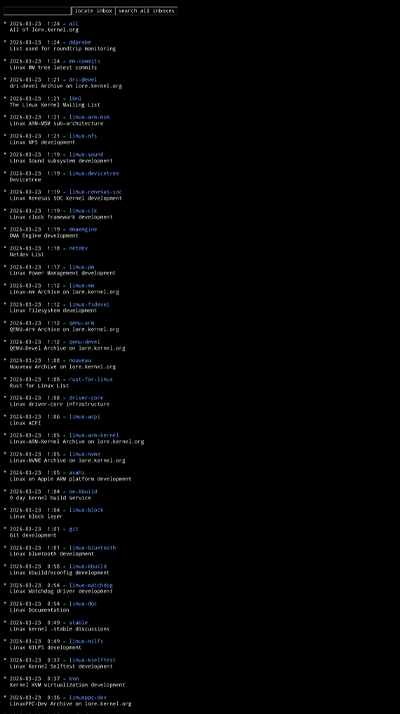
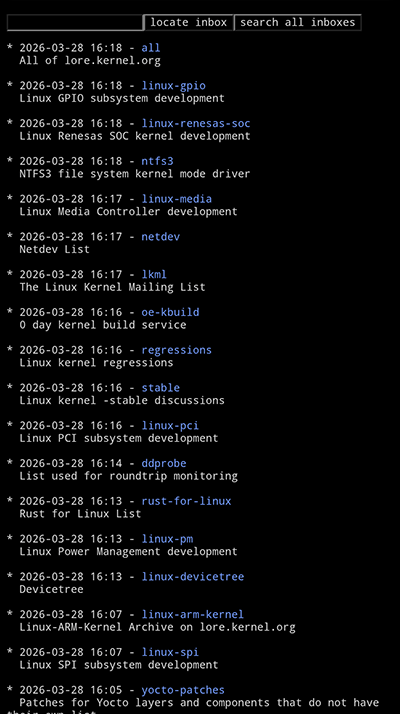
On March 28, 2026, Rito noticed lore.kernel.org had changed - the viewport meta tag was live and the archive was rendering correctly on mobile. The Wayback Machine captures the before and after: before (March 23) and after (March 28). The entire Linux Kernel Mailing List archive - one of the most important developer communication archives in existence - was now mobile responsive.
Designing Within 216 Colors:
Rendering correctly was not the same as being usable. In dark mode, the search input and submit buttons relied on browser default styling and were difficult to distinguish from the page background at all, which made them hard to identify as interactive controls.
A three-patch series proposed spacing around the header search inputs, explicit borders on form controls, and a pointer cursor on submit buttons. All three were rejected on one consistent principle: margins and borders cost screen space that low-resolution users cannot spare, and a cursor change would be the browser's job if it were worth doing.
The border rejection arrived with a counter-proposal: rather than outlining the controls, give them a background slightly different from the page, staying inside the 216 web-safe colors the project uses for compatibility. Eric suggested #003.
Rito tested it and disagreed with the value. #003 reads clearly at full screen brightness but loses its separation at normal-to-low brightness, which is where the problem actually bites. He shipped #033 instead, documenting why in the commit message: visible across the brightness range, without becoming intense enough to compete with the text sitting on top of it. It was applied as sent.
The reply asked whether the light theme needed the same treatment. That question turned into a further contribution: a complete dark sample theme built on the 22 safest web colors, a palette that skews light and saturated and offers almost nothing usable as a dark background. Each choice carried a written rationale: #003 as the closest thing to a conventional dark ground, #00f for inputs, #0f6 for links so they read as more salient than body text without extra decoration, and #3ff for visited links, distinct enough to signal a followed link while still reading as a link at all. Diff colors followed the conventions developers already carry in their heads.
This is design work performed with almost everything removed: twenty-two colors, no borders, no margins, no added bytes, legible on a CRT at 800x600 and beside a terminal browser. The constraint was the assignment.
Outcome:
The Linux Kernel Mailing List archive renders correctly on mobile, and its dark theme controls are identifiable as controls. Because the work went upstream into Public Inbox rather than into one host's local configuration, every instance of the software inherits it, not only the archive that prompted it.
Every patch that landed did so in a project whose maintainer opened by doubting the premise, does not run a graphical browser, and never saw a single screenshot of the result. Each change had to be argued on its own terms: bytes added, screen space spent, behavior across brightness levels, colors drawn from a palette of twenty-two. None of it was won by showing anyone that it looked better. It was won by being correct inside constraints that were not going to move.